Premium vs Budget Drone Features Compared

A $477 drone and a $75 drone can both promise aerial photography, 1080p video, USB charging, and app-friendly flying. On paper, that makes the cheaper model look like a steal. In practice, the gap shows up in range, stability, flight time, camera support, motor type, and the confidence you get when flying outdoors.
This comparison looks at two listing-based examples: a higher-priced RG106 Pro at $477 and a lower-cost 4DRC model at $75. The goal is not to crown one as “better” for everyone. It is to show what the extra $402 appears to buy, and where the budget drone still makes sense.

The quick feature snapshot
The biggest difference is simple: the premium drone is built around longer flights, longer distance, stronger motors, GPS features, and a stabilized camera mount. The budget drone is smaller, lighter, cheaper, and better suited to short-range casual flying.
Feature | $477 RG106 Pro | $75 4DRC |
Price | $477 | $75 |
Remote distance | 1,000 to 1,200 m | 80 m |
Flight time | 20 to 30 minutes | 10 to 20 minutes |
Motor type | Brushless motor | Brush motor |
Camera support | Integrated camera with 3-axis gimbal | Camera included |
Highest listed video resolution | 2048 x 1080P | Up to 2K QHD listed, also 1080p, 720p, 480p |
Highest listed photo resolution | 4096 x 3072P | Not specified |
Battery | 7.4V 3800mAh drone battery | Battery included, details limited |
Controller battery | 300mAh lithium battery included | 3 x AAA batteries, not included |
Size | 31 x 31 x 7.5 cm | 13 x 11 x 4 cm |
Weight | Not specified | About 32 g, takeoff weight about 55 g |
GPS | Yes | Not listed |
Obstacle avoidance | Yes | Not listed |
Auto return | Yes | Not listed |
Follow me | Yes | Not listed |
Recommended age | 14+ | 6 to 12 and 14+ listed |
Operator skill level | Expert | Not specified |
The spec sheet makes one thing clear: Premium vs Budget Drone Features Compared is really a comparison between two different use cases. The $477 drone aims at outdoor camera flying with more automation. The $75 drone aims at lightweight, entry-level fun.
Price does not just buy a bigger drone
The $477 model costs more than six times as much as the $75 model. That sounds like a huge jump, and it is. The useful question is what changes when the price climbs.
The premium drone includes several features that often matter during outdoor flights:
GPS
Auto return
Follow me
Obstacle avoidance
App control
Wi-Fi
3-axis gimbal
Brushless motor
Longer range
Larger battery
The budget drone still includes plenty for the price:
Remote controller
Camera
USB cable
Battery
Charger
Original box
Operating instructions
Multiple listed video resolutions
Small body
Low takeoff weight
That makes the cheaper drone easier to justify as a first drone, a gift, or a practice flyer. It is less of a commitment. If it gets scratched, bumped, or retired after a learning phase, the loss is smaller.
The premium drone asks for a different mindset. At $477, expectations rise. Buyers should expect better flight behavior, more useful camera work, and fewer limits once the drone leaves a small backyard or indoor space.
Range is one of the clearest gaps
Remote distance is one of the largest differences in the listing.
The RG106 Pro lists a range of 1,000 to 1,200 meters, which is roughly 0.62 to 0.75 miles. The 4DRC lists 80 meters, about 262 feet.
That gap changes how each drone feels in the air.
With the budget drone, 80 m is enough for learning basic controls, flying in an open yard, or taking simple nearby shots. It keeps the drone close, which can be a good thing for beginners. Short range also lowers the chance of losing orientation far away.
With the premium drone, the longer range supports broader outdoor use. It gives more room for wide landscape shots, longer tracking movements, and flights over larger open areas. The added distance also works better with features like GPS, auto return, and follow me.
Range should still be treated carefully. Local rules, signal conditions, battery level, line of sight, wind, trees, buildings, and interference all affect real-world flight. A listed maximum range is not a promise that every flight will reach that number safely.
The premium drone’s range is not just a bigger number. It supports a different style of flying, where distance, GPS, and return features matter more.
Flight time affects how useful the drone feels
The premium drone lists 20 to 30 minutes of flight time. The budget drone lists 10 to 20 minutes.
That difference matters more than it may seem. Short flights create pressure. A beginner may spend the first few minutes getting oriented, trimming controls, or finding a good angle. If the battery runs low right after that, the session feels rushed.
A 20 to 30 minute window gives more space for planned flying. It helps with:
Framing photos
Repeating video passes
Testing follow modes
Flying back safely
Handling small delays caused by wind or setup
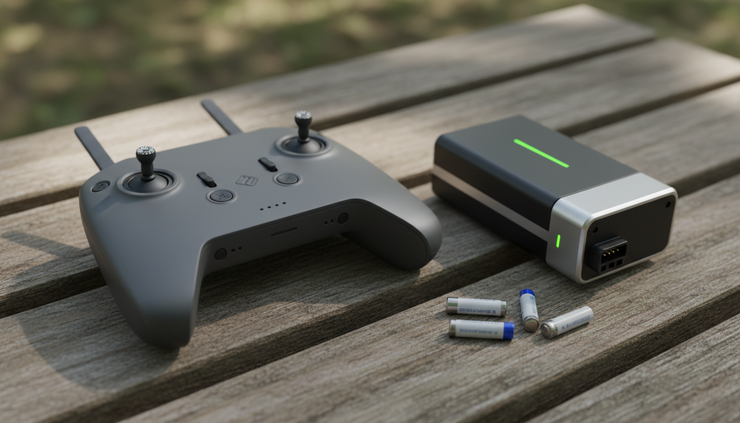
The RG106 Pro also lists a 7.4V 3800mAh drone battery. The controller uses a 300mAh lithium battery, and it is included. Charging time is listed at about 4 hours, with 110 to 220V charging support through USB.
The 4DRC listing says batteries are included, but the controller needs 3 x 1.5V AAA batteries, which are not included. That is not a major cost, but it is easy to overlook. If the goal is to fly right away, the premium package may feel more complete on the controller side.
The budget drone’s shorter flight time still fits short practice sessions. For kids, beginners, and casual pilots, that may be enough. For recording smooth video or flying outdoors for longer stretches, the premium drone has the edge.
Motors separate toy-like flying from stronger outdoor control
The $477 drone uses a brushless motor. The $75 drone uses a brush motor.
This is one of the most meaningful hardware differences.
Brushless motors are common in higher-quality drones because they tend to offer better efficiency, better durability, and stronger performance for their size. They usually handle longer flights and outdoor conditions better than brushed motors.
Brushed motors are cheaper and simpler. They are common in small beginner drones and toy-grade models. They can work well for light flying, but they tend to wear faster and may feel weaker in wind.
The 4DRC listing states an anti-wind ability of less than 10 km/h, which is about 6 mph. That suggests calm conditions are best. A very light drone can get pushed around easily, especially outdoors.
The RG106 Pro does not list a wind rating in the provided specs, but its larger size, brushless motor, GPS, and heavier battery setup all point toward more capable outdoor use.
Size plays into that too.
Measurement | $477 RG106 Pro | $75 4DRC |
Dimensions | 31 x 31 x 7.5 cm | 13 x 11 x 4 cm |
Listed weight | Not given | About 32 g |
Takeoff weight | Not given | About 55 g |
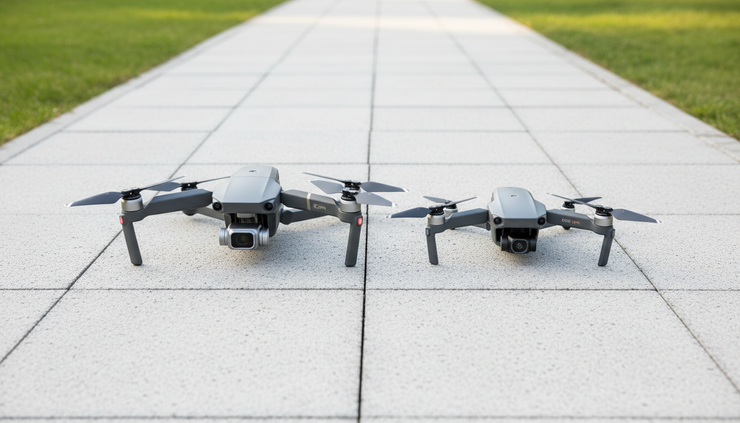
The smaller 4DRC is easy to carry and less intimidating. The larger RG106 Pro is more substantial and likely better suited to steadier outdoor flight.
Camera specs need careful reading
Both drones list aerial photography and video capture. Both include a camera. Both mention 1080p FHD somewhere in the listing.
The premium model lists:
Highest photo resolution of 4096 x 3072P
Highest video resolution of 2048 x 1080P
Integrated camera
3-axis gimbal
App control
Wi-Fi
The budget model lists several video capture resolutions:
1080p FHD
720p HD
2K QHD
480p SD
At first glance, the 4DRC’s “2K QHD” listing may look just as good, or even better, than the premium model’s listed video resolution. But resolution is only one piece of camera quality.
Aerial footage depends on stability as much as pixel count. This is where the RG106 Pro’s 3-axis gimbal becomes important. A gimbal helps keep the camera level and smooth while the drone tilts, turns, or moves through light wind. It can make footage look more controlled and less shaky.
The budget drone includes a camera, but no gimbal is listed. That usually means video may show more vibration, tilt, and movement. For quick clips, that can be fine. For cleaner aerial shots, the premium drone has a clear advantage.
Photo resolution also favors the premium model because the budget listing does not provide a highest photo resolution. If still images matter, that missing detail is worth noticing.

Smart flight features make the premium drone easier to trust
The RG106 Pro includes several automated features that are not listed for the budget 4DRC model.
The most important ones are GPS, auto return, obstacle avoidance, and follow me.
GPS helps the drone understand its position. That can improve hovering, return functions, and automated flight behavior. For outdoor camera work, GPS is one of the features that makes a drone feel less nervous to operate.
Auto return can help bring the drone back when needed. It should not replace careful piloting, but it is useful as a safety feature.
Obstacle avoidance can help reduce crashes, depending on how well the system works and where the sensors are placed. Listing the feature does not tell the full story, but its presence still separates the premium drone from a more basic model.
Follow me is useful for recording moving subjects, such as walking, biking, or driving in open spaces where drone use is allowed. It pairs naturally with GPS and app control.
The budget drone leaves these features out of the provided specs. That does not make it bad. It means the pilot should expect more manual control and less backup from automated systems.
Package contents and setup are closer than expected
Both drones are listed as remote-controlled, electric, lithium battery powered helicopter-style drones. Both use USB plugs. Both include batteries for the drone.
The budget 4DRC package is surprisingly complete for the price. It lists:
Original box
Batteries
Operating instructions
Charger
Remote controller
Camera
USB cable
The premium RG106 Pro package listing is shorter, with a USB cable specifically mentioned. It is also listed as ready-to-go, with the drone battery and controller battery included.
That reveals a useful buying lesson. A cheaper drone can sometimes list more box contents, while a pricier drone may put more money into the flight platform itself.
The 4DRC may feel more like a complete starter kit. The RG106 Pro may feel more like a higher-spec aircraft, especially because it adds GPS, brushless motors, a gimbal, and longer range.
Before buying either type, checking the actual package variation matters. Drone listings sometimes bundle different battery counts, camera versions, controllers, or accessories under similar product names.
Age and skill level point to different pilots
The premium drone lists a recommended age of 14+ and an operator skill level of expert. The budget drone lists 6 to 12 and 14+, which is unusual but suggests it is aimed at younger or beginner pilots as well as older users.
That difference fits the rest of the specs.
The 4DRC is small, light, short-range, and more affordable. It works best as a learning drone or casual flyer. Its 80 m range and light body reduce the pressure of piloting a more expensive aircraft.
The RG106 Pro has more advanced features and more responsibility. Longer range, GPS, camera modes, and obstacle avoidance add capability, but they also create more settings to understand. The pilot needs to manage battery life, return paths, signal strength, and safe flying space.
Age recommendations do not replace judgment. A careful beginner may handle a more advanced model with practice, while a younger pilot may need close adult supervision even with a small drone. The higher the range and weight, the more seriously flight safety should be treated.
Warranty and certification favor the premium listing
The RG106 Pro lists a 6-month warranty, with the buyer assuming return shipping cost. It also lists 3C certification. The 4DRC details provided do not include a warranty or certification note.
A warranty does not guarantee a smooth support experience, especially when return shipping is involved. Still, having a listed warranty is better than having no warranty information at all.
Certification information can matter for buyers who care about product compliance. The 3C mark relates to China Compulsory Certification for certain product categories sold in China. It does not replace checking local rules or import requirements, but it gives one more detail about the product listing.
For a $75 drone, warranty expectations are usually lower. For a $477 drone, support and parts availability become more important. If the gimbal, GPS, battery, or controller has an issue, repair or replacement can affect the real cost.
Which drone gives better value
Value depends on the job.
Choose the $75 4DRC if the main goal is low-cost practice, short flights, indoor-friendly handling, or a simple gift. It includes the core pieces needed to start flying, and its small size makes it easy to store and carry. It is the safer financial choice for someone who may not stick with the hobby.
Choose the $477 RG106 Pro if the main goal is outdoor aerial photography, longer range, smoother video, GPS-assisted flight, and automated features. The gimbal, brushless motor, larger battery, and return features make it a much stronger match for serious flying.
The budget model wins on price, size, and beginner appeal. The premium model wins on range, flight time, motor quality, camera stabilization, GPS, and smart flight tools.
The cleanest way to decide is to ignore the most eye-catching resolution claim and ask three questions:
Will the drone fly mostly indoors or outdoors?
Is smooth video more important than just having a camera?
Is this a learning purchase or a long-term flying tool?
If the answer points to practice and fun, the 4DRC makes sense. If the answer points to planned aerial footage and outdoor control, the RG106 Pro better fits the job.
Final takeaway
The $75 drone gives you the basics: a camera, remote control, battery, USB charging, and short-range flight. That is enough for learning and casual flying.
The $477 drone adds the features that matter when flights get longer and footage matters more: brushless motors, GPS, auto return, obstacle avoidance, follow me, longer battery life, wider range, and a 3-axis gimbal.
The price jump is not just about buying a more expensive drone. It is about buying more stability, more distance, more automation, and a better chance of getting usable aerial footage. For a first taste of flying, go budget. For real outdoor camera work, the premium feature set earns its place.
Explore more drones at Solid Shopping to shop smart & save big!



Comments